Digital Rights Management for Training Content
On this page 7 sections
Digital rights management protects training content by controlling who can open it, on which devices, for how long, and what they can do with it. For organizations that sell courses or hold licensed material, DRM turns unauthorised sharing from an invisible loss into a controllable one. It raises the cost of copying rather than making it impossible.
When content becomes a product, sharing becomes revenue loss
If your training is internal, someone forwarding a PDF is untidy. If your training is what you sell, the same act is a lost sale, and at scale it is a lost business model.
This is the position certification bodies, training providers, associations and publishers find themselves in. The course library is the asset. A single downloadable file circulating in a WhatsApp group can quietly serve a hundred people who would otherwise have paid, and the owner has no visibility that it happened.
Digital rights management is how you make that harder. Not impossible, and it is worth being honest about that upfront, but meaningfully harder in ways that change behaviour.
What DRM actually controls
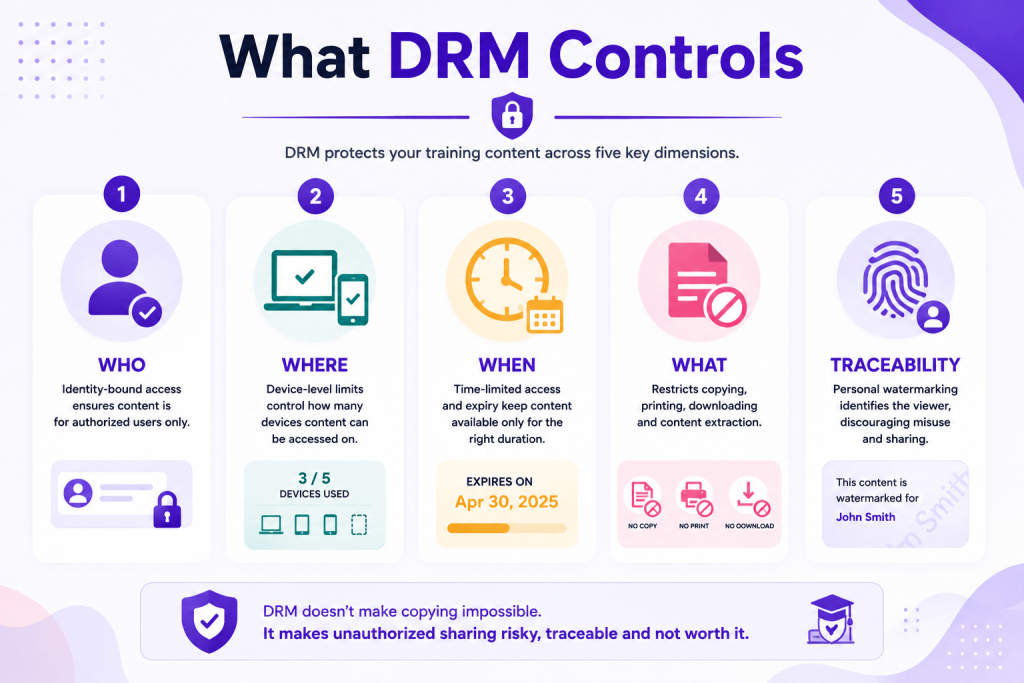
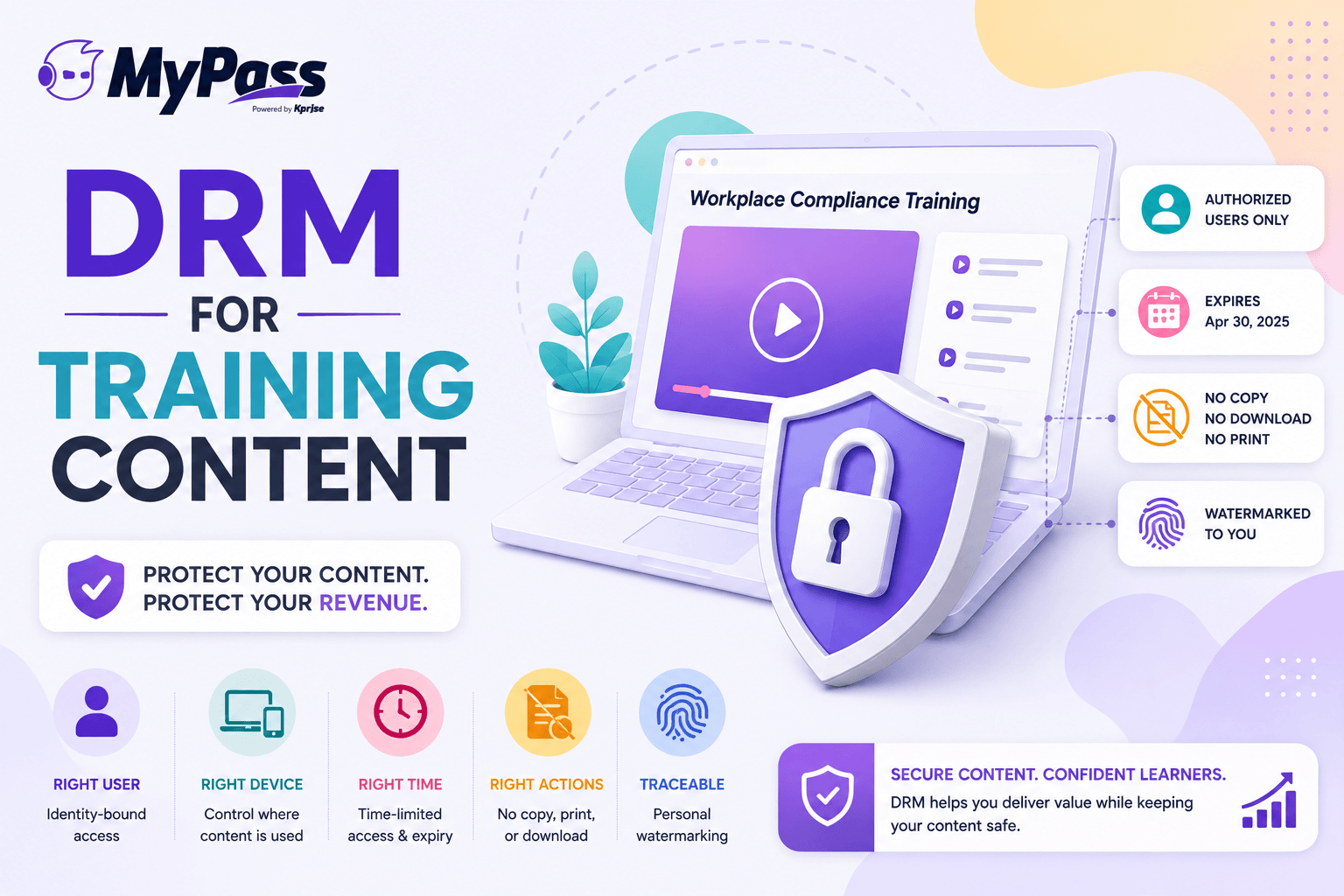
- Who. Access is bound to an identified user rather than to possession of a file, so sharing a link does not share the content.
- Where. Device-level access control limits how many devices a licence opens on, which stops one purchased account serving an entire team.
- When. Time-limited access and expiry, so content tied to a course enrolment or subscription period does not remain available indefinitely.
- What. A secure viewing environment that prevents copying, printing, extracting and downloading, rather than handing over a file and hoping.
- Traceability. Personal watermarking stamps the viewer's identity onto what they see, so any screenshot or photograph that does circulate points back to its source.
The last one is the most behaviourally effective. Technical prevention has limits, but visible personal attribution changes the calculation for the person deciding whether to share.
What DRM cannot do, and why that is fine
Any honest discussion of DRM has to acknowledge the analogue hole: someone can point a phone camera at a screen. No system prevents that.
So the goal is not perfect prevention, which is unachievable. It is raising the cost and the risk of copying until casual sharing stops being worth it:
- Casual sharing, which is the overwhelming majority of unauthorised distribution, is genuinely stopped. Most people forward a file because it is easy, not because they are determined to pirate it.
- Attribution is preserved. Watermarking means a leaked screenshot identifies its origin, which deters deliberate sharing among people who can be identified.
- Bulk redistribution becomes impractical. Photographing a two hundred page manual page by page is not a realistic substitute for buying it.
- Revocation becomes possible. If a licence is abused, access can be withdrawn, which is impossible once a file has left your control.
Key point
The right mental model is a lock on a door. It does not make entry impossible, it makes it inconvenient and obvious enough that most people do not try. Judged against perfect prevention, DRM always fails. Judged against unrestricted PDFs, it works.
Who genuinely needs it
- Training providers and course sellers, where the content is the product and every unauthorised copy is a lost sale.
- Certification bodies, where exam preparation material circulating freely undermines both revenue and the credential's integrity.
- Associations selling continuing education to members, where non-dues revenue depends on non-members not simply obtaining the material.
- Organizations handling licensed third-party content, where a distribution agreement may contractually require access controls.
- Anyone training on genuinely confidential internal material, such as proprietary processes or pre-release product information.
If your training is free internal onboarding, you do not need DRM. If someone pays for your content, or you pay someone else for it, you probably do.
How this works in MyPass LMS
Content protection is built into the platform rather than bolted alongside it, which matters because a separate DRM tool means a separate viewer, a separate login and a broken learner experience.
- Protected document distribution, so material is viewed rather than downloaded.
- A secure document reader providing a controlled viewing environment without copy, print or extraction.
- Device-level access control and content encryption.
- Personal watermarking for traceability.
Because it sits inside the same platform, protected content still behaves like normal course material: it is assignable, completions track into the same records, and it feeds the same audit and compliance reporting as everything else. Kprise also offers document DRM as a standalone product at mypassdrm.com for organizations that need protection outside a learning context.
For organizations selling courses through the platform, protection and commerce are two halves of the same decision. There is limited value in a smooth checkout if the purchased material is forwarded to everyone who did not buy it.
The bottom line
Digital rights management matters the moment training content becomes something people pay for. It controls who opens material, on what devices, for how long and what they can do with it, and watermarking preserves attribution when something does escape. It will not defeat a determined person with a camera, and it does not need to. It needs to stop casual sharing, which is most sharing, and it does that well.
See the platform features, learn how course selling works, or start a 15-day free trial.
Frequently asked questions
What is DRM for training content?
Digital rights management controls how training material can be accessed and used: binding access to identified users, limiting devices, setting expiry, preventing copying, printing and downloading, and watermarking content so any leaked copy is traceable to its source.
Can DRM completely stop content piracy?
No. Someone can always photograph a screen, which is known as the analogue hole. DRM's purpose is to raise the cost and risk of copying enough that casual sharing stops, which accounts for the overwhelming majority of unauthorised distribution, and to preserve attribution when material does leak.
Who needs DRM for their training content?
Training providers and course sellers, certification bodies protecting exam preparation material, associations selling continuing education, organizations distributing licensed third-party content under contractual access requirements, and anyone training on genuinely confidential internal material.
How does watermarking help protect course content?
Personal watermarking stamps the viewer's identity onto what they see, so any screenshot or photograph that circulates identifies its source. This is behaviourally effective because it changes the calculation for someone deciding whether to share, even where technical prevention has limits.
Does DRM make training harder for legitimate learners?
It should not, when protection is built into the platform. Content is viewed in a secure reader within the normal course experience, still assignable and still tracked. Friction appears when DRM is a separate tool requiring its own viewer and login.