GDPR Training for Employees: A Complete Programme Outline
On this page 6 sections
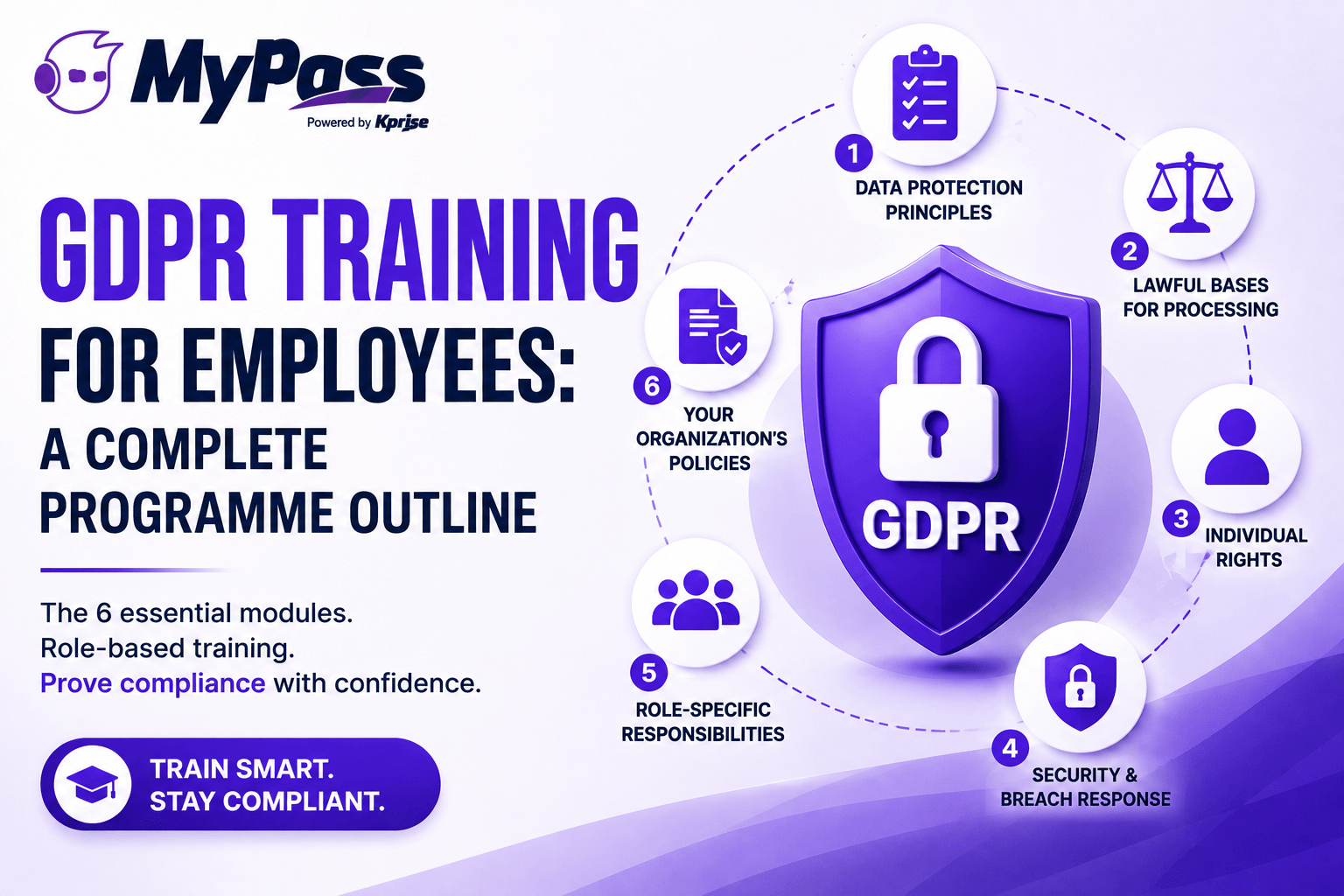
A complete GDPR training programme for employees should cover six modules: data protection principles, lawful bases for processing, individual rights, data security and breach response, role-specific responsibilities, and your organization's own policies. Everyone needs the fundamentals; staff who handle personal data need deeper role-specific training. As with any compliance programme, documented proof of completion — not just delivery — is what demonstrates you met your obligations.
GDPR training is a legal expectation, not a nice-to-have
Under the GDPR, organizations are expected to ensure staff who handle personal data understand their obligations — and 'we sent everyone a policy document' is not a defensible position if something goes wrong. Regulators look for evidence of genuine, ongoing awareness training, tailored to what people actually do with data.
This outline gives you a complete programme structure: the modules to cover, how to vary depth by role, and — the part organizations most often neglect — how to document completion so the training actually counts. The same discipline applies here as to HIPAA training : delivering the training is only half of it; proving you delivered it is what protects you.
The six-module programme
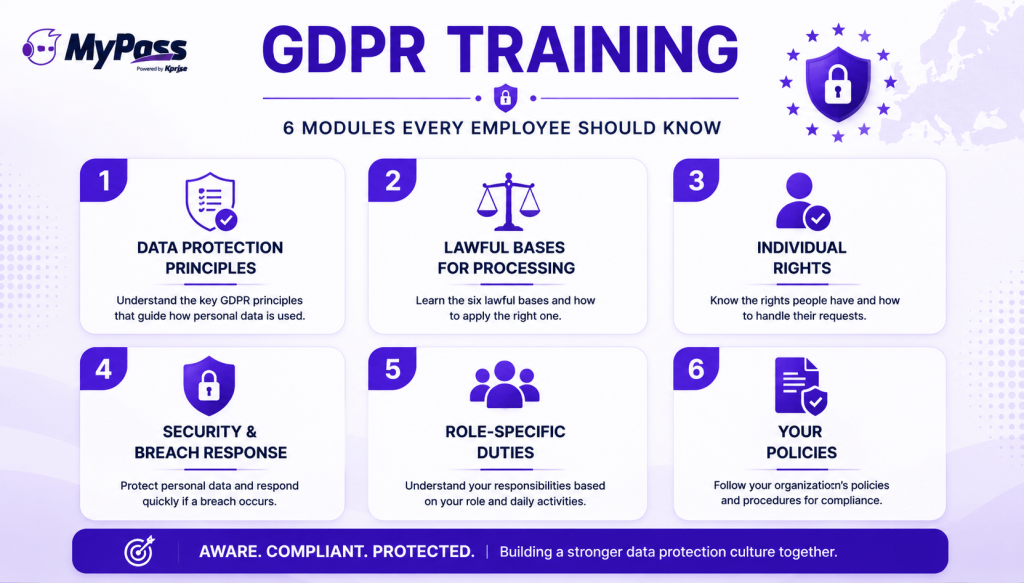
- Module 1 — Data protection principles. The core GDPR principles: lawfulness, fairness and transparency; purpose limitation; data minimisation; accuracy; storage limitation; integrity and confidentiality; and accountability. This is the conceptual foundation everything else builds on.
- Module 2 — Lawful bases for processing. The six lawful bases and how to identify which applies. Staff don't need to be lawyers, but they should recognize that personal data can't be processed just because it's convenient.
- Module 3 — Individual rights. The rights GDPR grants people — access, rectification, erasure, portability and others — and, crucially, how to recognize and escalate a request when one arrives, because the clock starts the moment it does.
- Module 4 — Data security and breach response. Practical safeguards for personal data, how to spot a potential breach, and the internal reporting steps that follow. GDPR's 72-hour breach-notification window makes fast recognition essential.
- Module 5 — Role-specific responsibilities. Tailored content for how each role handles personal data. Marketing, HR, and customer support face different GDPR realities, and abstract training doesn't stick — concrete, role-based scenarios do.
- Module 6 — Your organization's policies. The GDPR is the law; your policies are how your organization applies it. This module connects the principles to your actual procedures, tools and points of contact.
Who needs what: scaling depth by role
Not everyone needs the same GDPR training, and pretending they do wastes time and dilutes attention. A sensible structure has two tiers. Everyone in the organization completes the fundamentals — principles, individual rights awareness, and breach recognition — because anyone can receive a data request or spot a breach. Staff who routinely handle personal data (HR, marketing, sales, support, IT) complete deeper, role-specific modules on top.
This is where automatic, role-based assignment earns its keep. Rather than manually working out who gets which modules, a learning platform can assign the right training based on role or department — and adjust automatically when someone changes jobs.
Tracking completion so the training counts
A GDPR training programme you can't evidence is a GDPR training programme you might as well not have run, from a regulator's perspective. You need to be able to show who completed which modules, when, and demonstrate that the programme runs on an ongoing cadence rather than as a one-off.
- Assign modules automatically by role, so the right people get the right depth.
- Track completion and chase non-completers without manual email follow-up.
- Store each completion as a dated, exportable record.
- Refresh annually and document each cycle, since data-protection awareness isn't a one-time achievement.
Key point
→ Build the tracking once and it covers your whole compliance suite. The same system that documents GDPR training handles HIPAA , anti-harassment and audit-ready compliance reporting — one habit, many obligations covered.
The bottom line
A complete GDPR training programme runs on six modules — principles, lawful bases, individual rights, security and breach response, role-specific duties, and your own policies — delivered in two tiers so everyone gets the fundamentals and data-handlers get the depth. But the programme only protects you if you can prove it ran: documented, dated, role-appropriate completion records, refreshed on a cadence. Content plus proof, not content alone.
MyPass LMS lets you deliver GDPR and other compliance training with role-based automatic assignment, completion tracking and audit-ready records — with an immutable audit trail on every plan. See how to prove training compliance in an audit , or start a free trial .
Frequently Asked Questions
What should GDPR training for employees cover?
Six modules: data protection principles, lawful bases for processing, individual rights, data security and breach response, role-specific responsibilities, and your organization's own policies. Everyone needs the fundamentals; data-handlers need deeper role-specific training.
Is GDPR training mandatory for employees?
Under the GDPR, organizations are expected to ensure staff who handle personal data understand their obligations. Regulators look for evidence of genuine, ongoing awareness training tailored to roles — not just a distributed policy document.
How often should GDPR training be refreshed?
GDPR awareness training should be recurring, typically annually, plus when policies change or new staff join. Each cycle should be documented with dated completion records.
Does everyone need the same GDPR training?
No. A two-tier approach works best: everyone completes the fundamentals, while staff who routinely handle personal data complete deeper, role-specific modules. Role-based automatic assignment makes this manageable.
How do I prove employees completed GDPR training?
Use a learning platform that records who completed which modules and when, stores it as dated, exportable records, and demonstrates an ongoing cadence. Delivery alone isn't enough — documentation is what evidences compliance.
Keep reading
Compliance training
AML Training for Employees: A Plain-English Guide

Compliance training
Fire Safety Training Requirements: What Employers Need to Know
Compliance training
SOP Training: How to Get People to Actually Follow Procedures
Compliance training