Moodle Alternatives: Free and Open-Source LMS Options Compared
Moodle alternatives compared for 2026: Open edX, Canvas LMS, Chamilo and open-core MyPass LMS by license, hosting and fit, plus a Moodle migration checklist.
On this page 8 sections
Short answer
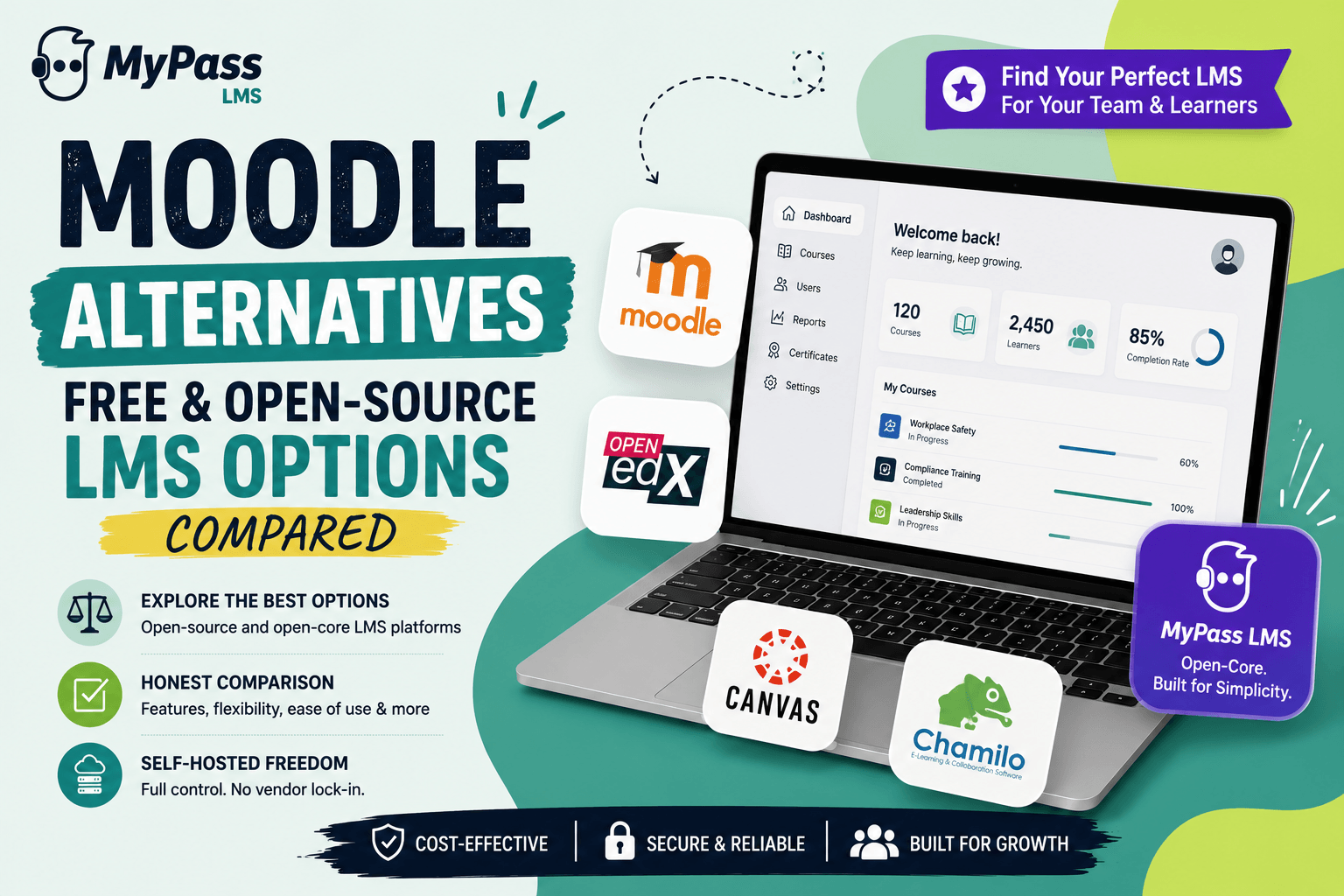
The main Moodle alternatives are Open edX, Canvas LMS and Chamilo among open-source platforms, plus open-core options like MyPass LMS that pair a free self-hosted edition with paid managed hosting. Choose Canvas for a modern academic interface, Open edX for large-scale course catalogs, Chamilo for lighter self-hosting, and open-core when you want a free core without running servers forever.
Moodle is free, open-source and pedagogically deep, which is why so many institutions run it. Teams start looking at Moodle alternatives when the learner interface, the upgrade cycle and plugin maintenance cost more staff time than the free license saves. This guide covers both sides: where Moodle still wins, why teams leave, how the main free and open-source alternatives compare on license and hosting, how to choose, and a checklist for moving off Moodle without losing learner records.
Why people look past Moodle
Moodle's core code is released under the GNU General Public License, version 3 or later, according to Moodle's developer documentation, and Moodle's public statistics list 148,633 registered sites in 237 countries. It is genuinely capable: quizzes, gradebooks, SCORM, competencies, rubrics and a community plugin directory that fills most gaps. Institutions standardize on it for good reason. Yet the organizations that leave give the same few reasons, and most of them are about operations rather than features.
Where Moodle genuinely wins: stay if this is you
An alternatives guide that only criticizes Moodle would not help you, because for many organizations Moodle remains the right answer. Stay with Moodle if:
- You need deep customization and have developers. Full source access plus the plugin directory means Moodle bends to almost any requirement, as long as someone can build and maintain it.
- You are an academic institution with demanding assessment needs. Moodle's question types, rubrics and competency frameworks are academic-grade.
- Data sovereignty matters and you can self-host. That is why many governments and universities run their own instance.
- You need free at very large scale and your IT staff's time is not charged to the LMS budget.
- Your only complaint is hosting. Moodle offers its own hosted service, MoodleCloud, and Moodle Certified Partners sell hosting and managed services, so you can stop running servers without changing platforms.
Key point
Moodle's license is free; running it is not. If you have technical staff to absorb upgrades, plugin checks and server work, and you value the customization, Moodle is hard to beat. If you do not, first price a hosted Moodle option, then compare it with the alternatives below.
The real reasons teams leave Moodle
- A dated learner experience. Moodle's interface has improved with each release and still gets described as clunky. Course completion is partly a user-experience metric, so that friction quietly suppresses engagement.
- Upgrades are a recurring project. Moodle ships a major release every April and October, and a standard release gets about 12 months of general support, per the Moodle releases page. Self-hosters either upgrade at least once a year or sit on a long-term support version: 4.5 LTS has security support until October 2027, and 5.3 LTS, released 5 October 2026, until October 2029.
- Upgrades break things. The Moodle 5.1 upgrade guide says you can only reach 5.1 from 4.2.3 or later, every plugin and theme needs a compatible version, and the web root moved to a new
/publicfolder, so your web server configuration has to change too. - Administration becomes someone's job. Hosting, security hardening, backups and plugin vetting are on you, permanently, unless you pay for MoodleCloud or a partner.
- You are a business, not an institution. Moodle's academic depth is more than many corporate, compliance and association programs need when they mostly want clean delivery, tracking and certificates.
The best Moodle alternatives compared
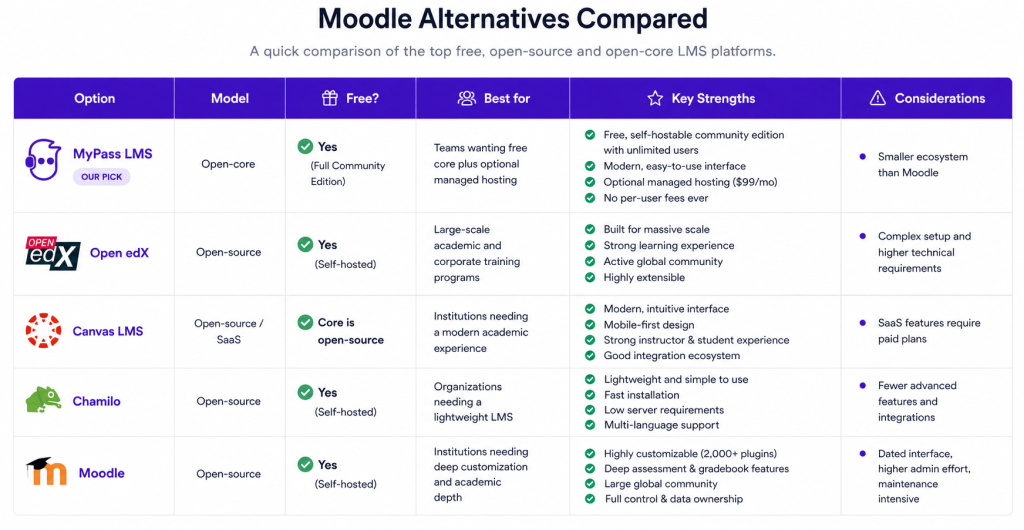
Licenses, versions and hosting options below were checked against each project's official site in October 2026. Moodle is included as the baseline.
| Tool | License | Hosting | Best for | Watch out for |
|---|---|---|---|---|
| MyPass LMS | Open-core: free Community Edition, paid hosted plans | Self-host, or vendor-hosted from $99/month | Associations, certification programs, corporate and compliance training | Much smaller community than Moodle; the self-host download is a Windows bundle today |
| Open edX | AGPLv3 | Self-host with Tutor, or a paid service provider | Large-scale course catalogs and MOOC-style programs | Built for teams with technical expertise; heavy for a small organization |
| Canvas LMS | AGPLv3 code; hosted Canvas sold by Instructure | Self-host on Linux, or Instructure's cloud | Schools and universities wanting a modern course interface | Self-hosting needs Ruby on Rails, PostgreSQL 14+ and Redis, with community-only help |
| Chamilo | GPLv3+ | Self-host on PHP hosting, including one-click installers | Smaller deployments that want simple open-source self-hosting | Two active branches (3.0 and legacy 1.11.x); check plugin and theme support |
| Moodle (baseline) | GPLv3 or later | Self-host, MoodleCloud, or Moodle Certified Partners | Academic depth and heavy customization | Twice-yearly releases; upgrades and plugin compatibility are your job when self-hosting |
MyPass LMS
MyPass LMS is an open-core platform from Kprise, a Bethesda, Maryland company that has built training and certification software since 2010; it is used by 130+ organizations in 11 countries. The free, self-hosted MyPass Community Edition includes unlimited registered users, certificates, SCORM support and reporting, and the same platform is available as a hosted service. It also has native AMS integrations (iMIS, Nimble AMS, MemberClicks, Fonteva, NetForum, YourMembership, GrowthZone, Personify), which matters for associations. Watch out for: a far smaller community and plugin ecosystem than Moodle's, and the Community Edition download is currently a Windows bundle, with macOS and Linux bundles listed as coming.
Open edX
Open edX is the open-source platform built for large online course catalogs. Its platform code is licensed under version 3 of the AGPL. The project's installation options page recommends Tutor for self-hosting and calls that route ideal for teams with technical expertise, because setup, maintenance and infrastructure are yours; service providers can host and manage it instead. Open edX ships named releases roughly every six months, and the current release is Verawood. Watch out for: it is more platform than a typical 200-person company needs, and heavier to run than Moodle.
Canvas LMS
Canvas has an open-source core, released under AGPLv3, and a more modern interface than Moodle, which makes it popular in education. Instructure sells hosted Canvas in three tiers through its sales team. The production install guide targets Linux or macOS servers (tested on Ubuntu 22.04), requires PostgreSQL 14 or later and Redis, recommends at least 8 GB of RAM, and points self-hosters to the community mailing list and IRC for help. Watch out for: Instructure's product page markets the hosted tiers and does not present the open-source version as a supported product.
Chamilo
Chamilo is a lighter open-source option that is simpler to self-host than Moodle, good for smaller deployments. It is free software under GPLv3+. The Chamilo download page lists Chamilo LMS 3.0.1 (19 September 2026, PHP 8.3 to 8.5) as the latest version and still offers the legacy 1.11.x branch (1.11.40, June 2026, PHP 7.4 and 8.3). The project repository mentions third-party installers such as Softaculous, Installatron and the DigitalOcean marketplace. Watch out for: decide which branch you are on before you build, because plugins and themes may not cover both, and some AI features rely on paid external services.
How to choose a Moodle alternative
Start from the problem you want to remove, not from a feature list. Work down this list and stop at the first rule that matches:
- The only problem is hosting and upgrades: keep Moodle and move it to MoodleCloud or a Moodle Certified Partner. Same courses, no migration.
- Nobody can own an upgrade rehearsal on a test copy twice a year: rule out self-hosting anything, Moodle included, and compare vendor-hosted plans only.
- You are a school or university and the complaint is the teaching interface: shortlist hosted Canvas.
- You publish open courses to tens of thousands of learners and have DevOps staff: shortlist Open edX.
- You want to stay open-source with a smaller footprint on ordinary PHP hosting: shortlist Chamilo.
- You are a business, association or nonprofit training staff, members or customers, and want a free core with the option to hand hosting to the vendor: shortlist an open-core LMS.
Tip
Before you shortlist, write down three numbers for the last 12 months: staff hours spent on Moodle upgrades and plugin fixes, hosting cost, and learner support tickets about the interface. The largest number tells you which rule above applies to you.
Moodle migration checklist
Most Moodle migrations go wrong on records, not courses. Work through this list before you sign with a new vendor, and see our guide to switching LMS platforms without losing data for the cutover itself.
- Inventory what you run. List active courses, the activity types they use, and every third-party plugin from Site administration > Plugins overview. Plugins with no equivalent are your real migration risk.
- Decide what moves. Migrate courses with enrollments in the last 12 months; archive the rest.
- Archive full course backups. A Moodle course backup (.mbz) can include users, completion details, course logs and grade history. Keep one with user data for every course you might need to prove completion for later.
- Export questions separately. Moodle can export questions from the question bank in Aiken, GIFT, Moodle XML or XHTML format. Check which formats the new LMS imports before you export.
- Sort content into "moves as-is" and "rebuild". SCORM packages move to any SCORM-compliant LMS unchanged; native lessons, books, forums and workshops usually have to be rebuilt.
- Map users and access. Match profile fields, cohorts to groups, roles, and your SSO or authentication method. Decide whether past completions import as records or stay in the archive.
- Pilot one course with real learners for two to four weeks, including certificate issue and a report run.
- Cut over on a fixed date. Stop new Moodle enrollments, keep Moodle read-only through at least one reporting or audit cycle, and update links, bookmarks and certificate verification URLs.
Open-core: free self-hosting with a managed option
Open-core sits between Moodle-style open source and a pure SaaS LMS. The vendor publishes a free core you can self-host and sells hosting and support on top. You give up the size of Moodle's community and depend on one vendor's roadmap; in return, the company that writes the software can also run it for you, so you are not shopping for a separate hosting partner. Our explainer on open-core vs open-source LMS licensing covers the differences in detail.
In MyPass LMS
The MyPass Community Edition is free to self-host with unlimited registered users. Hosted MyPass plans start at $99/month ($79/month billed annually) for up to 50 simultaneous logins, with no per-seat fees and a 15-day free trial without a credit card. Both run the same MyPass platform, so moving from self-hosted to Kprise-hosted does not mean switching LMS. For a feature-by-feature view, see the MyPass LMS and Moodle comparison or our MyPass LMS vs Moodle write-up.
Frequently asked questions
What are the best alternatives to Moodle?
The most common Moodle alternatives are Canvas LMS for a more modern academic interface, Open edX for large-scale course catalogs, and Chamilo for lighter self-hosting, all open-source. Open-core platforms such as MyPass LMS add a free self-hosted edition plus paid vendor hosting. The best fit depends on which problem you are solving: the interface, the hosting workload or cost.
Is there a free alternative to Moodle?
Yes. Open edX and the Canvas LMS source code (both AGPLv3) and Chamilo (GPLv3) are free to download and self-host, and open-core platforms such as MyPass LMS offer a free self-hosted Community Edition. Free means no license fee, not no cost: you still pay for servers, upgrades and the staff time to run them, or for a hosted plan.
Why do people switch from Moodle?
The usual reasons are a dated learner interface, a twice-yearly release cycle with plugin compatibility checks on every upgrade, ongoing hosting and security work, and academic depth that corporate, compliance or association training does not need. If hosting is the only problem, moving Moodle to MoodleCloud or a Moodle Certified Partner is usually simpler than migrating to a new platform.
Is Canvas better than Moodle?
Canvas is usually chosen for its cleaner course interface, while Moodle offers deeper assessment options and more customization through plugins. Canvas's source code is AGPLv3, but Instructure's main offering is hosted Canvas. Self-hosting Canvas requires a server running Ruby on Rails, PostgreSQL 14 or later and Redis, and help comes from the community rather than a support contract.
Can I migrate my courses out of Moodle?
Partly. SCORM packages move to any SCORM-compliant LMS unchanged. Quiz questions export from the question bank in Aiken, GIFT, Moodle XML or XHTML format. Native activities such as lessons, books and forums usually need rebuilding. Course backups (.mbz) can include completion details, grade history and logs, so keep them as an archive of learner records after you switch.
What's the difference between Moodle and an open-core LMS?
Moodle is open-source under the GPL: free to self-host, with hosting available from MoodleCloud or Moodle Certified Partners. An open-core LMS such as MyPass LMS publishes a free self-hosted core and sells hosting and support from the same vendor that writes the software. Open source gives you a larger community; open-core gives you one vendor responsible for both the software and the hosting.
Keep reading
Choosing an LMS
Open edX Alternatives: 7 Options Worth Comparing
Choosing an LMS
What Is an Open-Source LMS?
Choosing an LMS
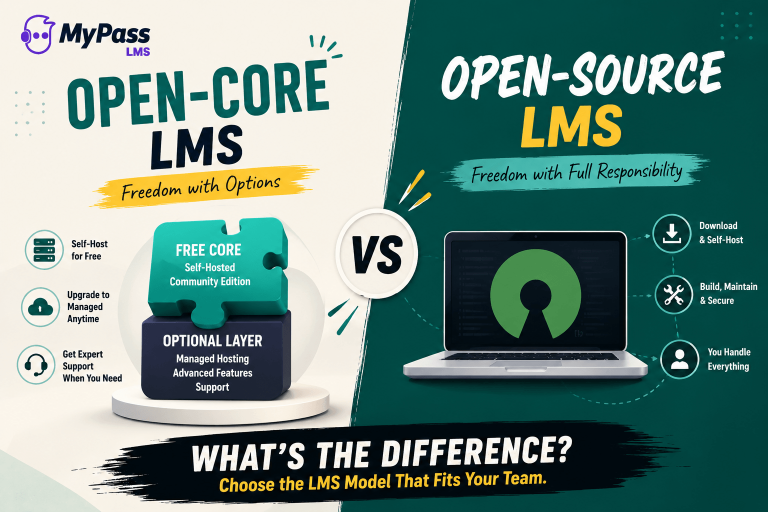
Open-Core LMS vs Open-Source LMS: What's the Difference?
Choosing an LMS