How to Measure Training Effectiveness (Kirkpatrick + ROI)
How to measure training effectiveness with the Kirkpatrick model: what to measure at each level, survey questions, a Phillips ROI example and a 90-day plan.
On this page 9 sections
- The Kirkpatrick four levels: what to measure, how and when
- Plan from Level 4 backward, before the training is built
- Sample Level 1 survey questions
- Sample Level 3 behavior questions for learners and managers
- Where Phillips ROI fits, with a worked example
- Choosing training effectiveness metrics by training type
- A 90-day training measurement timeline
- Common training measurement mistakes
- Frequently asked questions
Short answer
To measure training effectiveness, choose the business result the program should move and record a baseline before training. Then collect evidence at the four Kirkpatrick levels: reaction (survey on day 0), learning (pre-test and post-test), behavior (manager check at 30 to 60 days) and results (the target metric at 90 days). Add a Phillips ROI calculation only for costly, high-visibility programs.
Most teams that say they measure training are tracking two things: completion rate and a satisfaction survey. Completion tells you people finished. A good survey score tells you they did not mind it. Neither tells you whether anyone does the job differently, or whether the number the business cares about moved. This guide gives you a working method: the four levels with what to measure at each one, sample survey questions you can copy, a worked ROI example, metrics by training type and a 90-day schedule. If you want a longer list of individual KPIs, see our companion post on training metrics and KPIs for L&D teams.
The Kirkpatrick four levels: what to measure, how and when
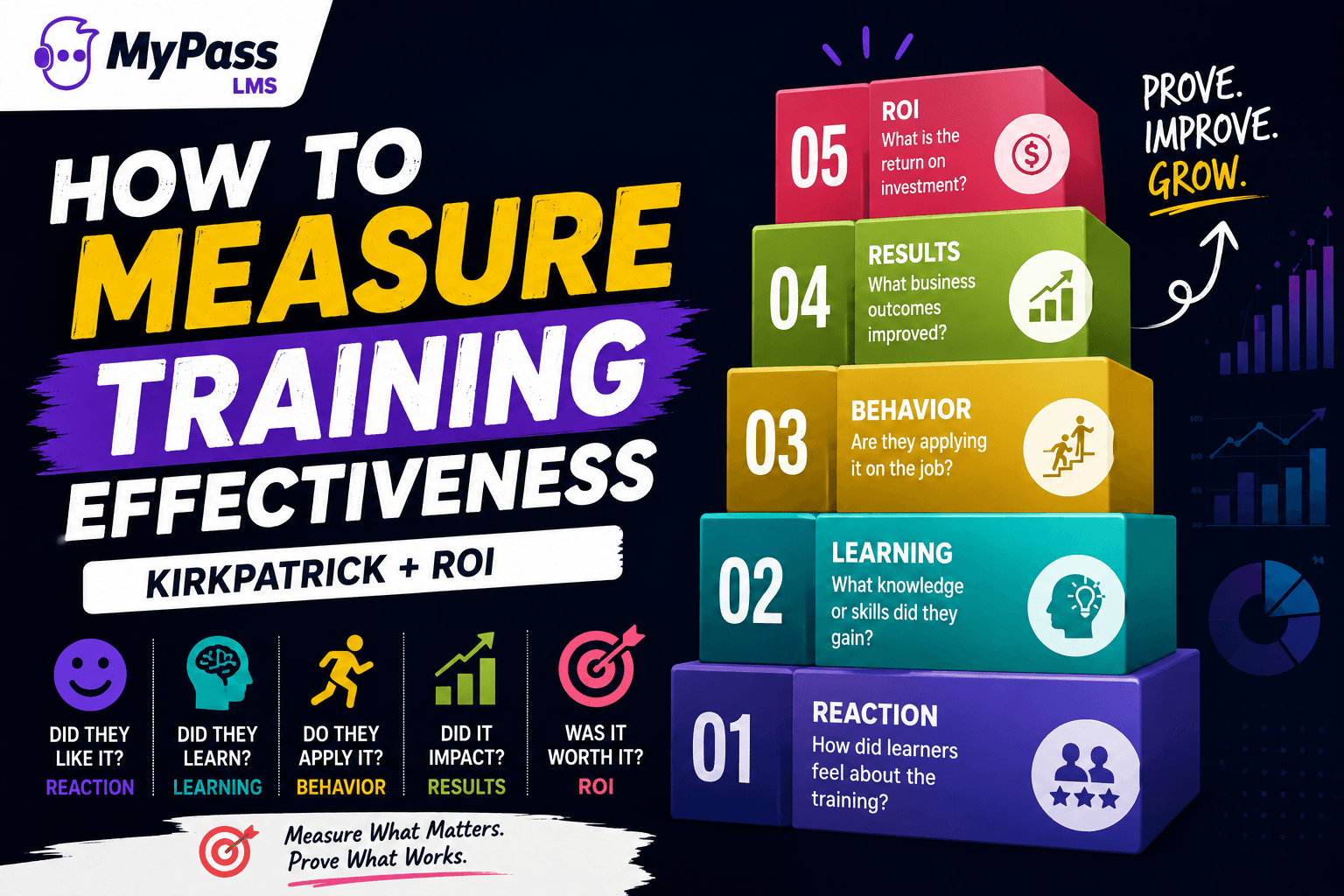
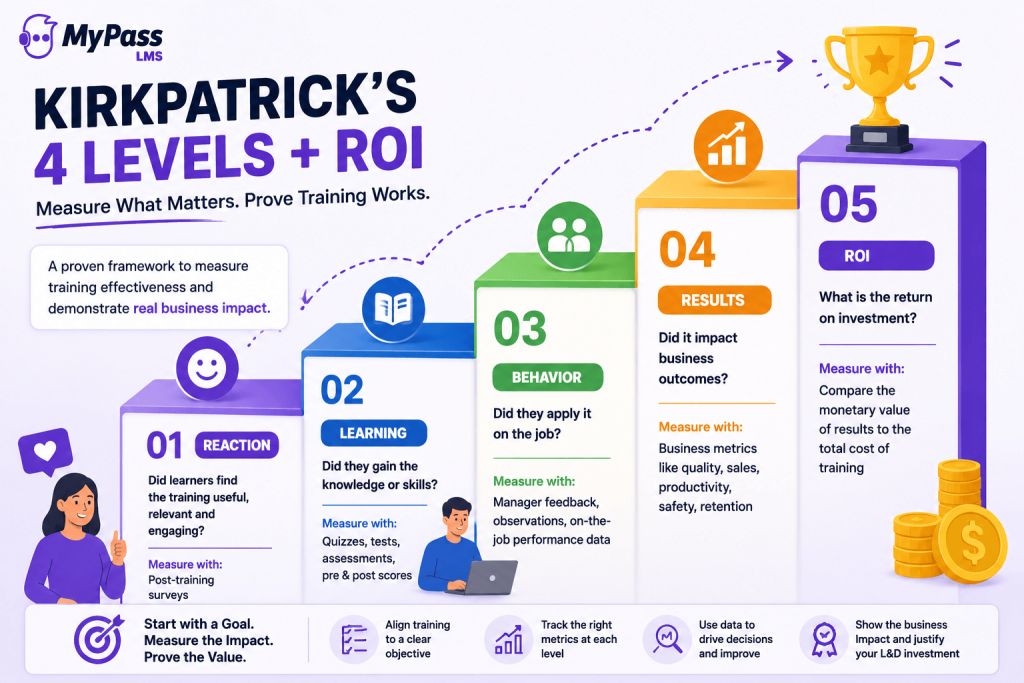
The model was created by Dr. Donald Kirkpatrick in the 1950s and is maintained today by Kirkpatrick Partners. Their current definitions are worth reading because they go further than the version most blog posts repeat. Level 1 is about whether learners find the training favorable, engaging and relevant, and Kirkpatrick Partners notes that relevance is the stronger predictor of whether people apply what they learned. Level 2 covers "knowledge, skills, attitude, confidence, and commitment", not only test scores. Level 3 looks at whether people perform the critical behaviors on the job and whether they are supported in and accountable for doing so. Level 4 measures whether the targeted organizational outcomes occur.
| Level | What you measure | How | When | Sample metric |
|---|---|---|---|---|
| 1. Reaction | Relevance, engagement, whether learners intend to use it | Short survey, 5 to 8 questions, at the end of the course or session | Day 0, before learners close the course or leave the room | % of learners who rate "I will use this in my job within two weeks" 4 or 5 out of 5 |
| 2. Learning | Knowledge, skill, confidence and commitment | Pre-test and post-test drawn from the same question pool; skill demonstration scored with a rubric; confidence rating | Pre-test before training, post-test at the end, short retest at day 30 | Average pre-to-post score gain, plus first-attempt pass rate at your cut score |
| 3. Behavior | Whether people perform the critical behaviors on the job, and what helps or blocks them | Manager observation checklist, learner self-report, system data such as QA scores, CRM fields or audit findings | Day 30 to day 90 | % of observed calls where the agent follows the four-step verification process |
| 4. Results | The business outcome the program was built to move | Operational data you already own, compared against the baseline and, where possible, an untrained comparison group | Day 60 to day 180, depending on how quickly the metric responds | Tier-2 escalations per 100 tickets; recordable safety incidents per quarter |
Levels 1 and 2 are cheap and fast, which is why most programs stop there. Levels 3 and 4 take planning and a manager's time, but they are the only levels that answer the question your budget holder will ask.
Plan from Level 4 backward, before the training is built
Kirkpatrick Partners states that "it is critical to start with Level 4: Results" and teaches planning from Level 4 down to Level 1. In practice that means the measurement plan exists before the first slide does. Work through these steps with the business owner of the metric, usually a department head or operations manager:
- Name one Level 4 metric and its owner. "Reduce tier-2 escalations" is a metric. "Improve customer service" is not.
- Pull a baseline. Take at least the last three months of that metric so a normal monthly swing is not mistaken for a training effect.
- List two to four critical behaviors. These are the observable actions that should move the metric, for example "agent runs the diagnostic checklist before escalating".
- Write the Level 2 test against those behaviors. Scenario questions and skill demonstrations beat recall questions. Our guide to writing measurable learning objectives shows how to phrase each objective so it can be tested.
- Write the Level 1 survey last, weighted toward relevance and intent to apply.
- Decide how you will separate the training effect. A team or site that trains a month later makes a simple comparison group.
Key point
Agree on what counts as success before launch, in writing: for example, "escalations fall by at least 10 per 100 tickets within 90 days, and 80% of observed calls follow the checklist." A target set after the data arrives will always look met.
Sample Level 1 survey questions
Keep the Level 1 survey to five to eight items so learners actually finish it. Use a 1 to 5 agreement scale for the rated items and end with one open question. Leave out questions about the room temperature or the lunch unless you plan to act on the answers.
- The content was relevant to the work I do every week.
- I will use at least one thing from this training in my job within the next two weeks.
- I feel confident I could do [named task] without help.
- The examples and practice matched situations I actually face.
- The length of the training was about right for the content.
- I know where to find help or reference material when I apply this.
- Open question: What is likely to stop you from using this on the job?
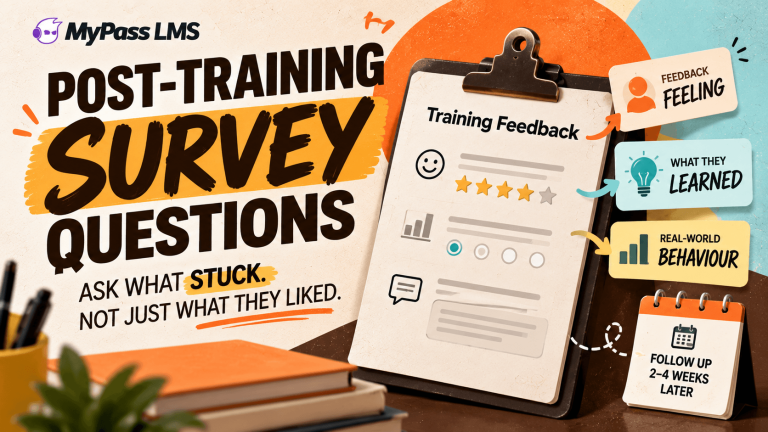
Questions 2, 3 and 7 do the most work: they give you an early read on Level 3 and flag barriers you can fix before day 30. For more question sets by training format, see our list of post-training survey questions.
Sample Level 3 behavior questions for learners and managers
Send the learner version at day 30 and ask the manager to complete the checklist version between day 30 and day 60. Asking both sides gives you a cross-check, since self-reports tend to run higher than what managers observe.
Learner self-report (day 30)
- In the last 30 days, how often have you used [critical behavior]? Never / once or twice / weekly / daily.
- Describe one situation where you used it. What happened?
- Which part of the training have you not used yet, and why?
- Has your manager discussed the training with you since it ended? Yes / No.
- What tool, time or permission would help you apply it more?
Manager observation checklist (day 30 to 60)
- I observed [critical behavior] on [number] occasions this month. Performed correctly: [number].
- Compared with before the training, this person's performance on [task] is: worse / same / somewhat better / much better.
- What is still getting in the way: skill, time, tools, process, or motivation?
- Does this person need a refresher, coaching, or nothing further?
Where Phillips ROI fits, with a worked example
The Phillips ROI Methodology, from the ROI Institute, adds a fifth level on top of Kirkpatrick's four: return on investment. The levels it uses are reaction and planned action, learning, application and implementation, business impact, and ROI. Two steps make it more credible than "benefits minus costs": you isolate how much of the improvement the program caused, using methods such as control groups, trend line analysis or estimates, and you convert the Level 4 result to money using standard values or historical costs. The formulas are:
- Benefit-cost ratio (BCR) = program benefits ÷ program costs
- ROI (%) = (program benefits − program costs) ÷ program costs × 100
Example
Illustrative example with made-up round numbers, not real data. A support team of 40 agents takes troubleshooting training. Fully loaded cost: $10,000 content, $6,000 facilitation and platform, $16,000 of agent time (40 agents × 8 hours × $50), $3,000 evaluation time, so $35,000 in total. Trained agents' escalations fall by 100 a month. An untrained comparison team falls by 40 a month over the same period (a new knowledge base article helped everyone), so 60 a month is attributed to training. Finance values one escalation at $75. Counting 12 months only: 60 × 12 × $75 = $54,000 in benefits. BCR = $54,000 ÷ $35,000 = 1.54. ROI = ($54,000 − $35,000) ÷ $35,000 × 100 = 54%.
Notice what the comparison team did to the result: without it, the claim would have been 100 escalations a month and an ROI more than twice as high, which a finance reviewer would rightly reject. The ROI Institute also asks you to report intangible benefits, such as job satisfaction or customer satisfaction, alongside the number rather than forcing a dollar value onto them. A full ROI study takes real effort, so save it for programs that are expensive, strategic or under budget scrutiny. Our step-by-step guide on how to calculate training ROI covers cost categories and conversion methods in more depth.
Choosing training effectiveness metrics by training type
The same four levels apply to every program, but the metric that proves effectiveness changes with the type of training. Use this table to pick one metric per level.
| Training type | What "effective" means | Level 2 metric | Level 3 metric | Level 4 metric |
|---|---|---|---|---|
| Compliance (harassment prevention, HIPAA, data privacy, safety) | People know the rule, follow it, and you can prove it to an auditor | Pass rate at the cut score; most-missed questions | Policy exceptions found in audits; phishing simulation click rate; near-miss reports filed | Audit findings, incidents, fines; % of staff current on required training before the due date |
| Skills (sales, software, technical, customer service) | People do the task better or faster | Skill demonstration scored with a rubric; scenario questions | QA scores, CRM activity, error rate on the task, manager checklist | Win rate, deal size, first-contact resolution, rework cost |
| Onboarding | New hires reach full productivity sooner and stay | Role-knowledge checks per module | Manager sign-off on core tasks at day 30, 60 and 90 | Time to proficiency, 90-day retention, first-year turnover |
For compliance programs, completion and certificate records do matter because they are your audit evidence, but treat them as the floor, not the finish line. Our page on compliance training software covers how to keep those records current. For onboarding, time to proficiency is the metric most worth negotiating with hiring managers up front, because "proficient" has to be defined per role. See how a structured employee onboarding program can track those day-30, 60 and 90 sign-offs.
A 90-day training measurement timeline
| When | What to do | Level | Owner |
|---|---|---|---|
| Weeks −4 to −1 | Agree the Level 4 metric and success target; pull 3 months of baseline; choose a comparison group; run the pre-test | 4, 2 | L&D with the business owner |
| Day 0 | Level 1 survey, post-test, record completion and first-attempt pass rate | 1, 2 | L&D (automated in the LMS) |
| Days 7 to 14 | Send a job aid or reminder; one-question pulse: "Have you used it yet?" | 3 (early signal) | L&D |
| Day 30 | Learner self-report survey; 5 to 10 question retention retest; manager checklist opens | 2, 3 | L&D, managers |
| Day 60 | Manager observation or system data check on the critical behaviors; remove barriers; schedule refreshers | 3 | Managers, QA |
| Day 90 | Compare the Level 4 metric with baseline and the comparison group; write a one-page readout; run ROI if the program warrants it | 4, 5 | L&D with finance |
Tip
Put the day-30 and day-60 manager checks in managers' calendars on launch day. Level 3 data goes missing far more often because nobody asked for it on time than because it was hard to collect.
Some Level 4 metrics, such as annual turnover or audit outcomes, will not settle in 90 days. In that case report Levels 1 to 3 at day 90 as leading evidence and schedule a second Level 4 check at six months.
In MyPass LMS
In MyPass LMS, you can build the pre-test and post-test from the same question pool in Assessments so both versions are comparable, run the Level 1 and day-30 questionnaires with Surveys, and issue certificates automatically when learners pass. Dynamic Reports pull scores and completions by group, which gives you the Day 0 numbers without manual exports. Our post on training analytics and Dynamic Reports shows the reports in detail.
Common training measurement mistakes
- Reporting completion as effectiveness. A 98% completion rate on a course nobody applies is a 98% completion rate, nothing more.
- No baseline. Without the pre-training number for the Level 4 metric and a pre-test for Level 2, you cannot show change, only a snapshot.
- Treating a high satisfaction score as proof. Learners can enjoy a session and change nothing. Use Level 1 to spot problems, not to prove value.
- Testing recall instead of the job. If the post-test asks for definitions but the job requires judgment, Level 2 scores will not predict Level 3.
- Skipping Level 3 or measuring it on day 3. Behavior needs weeks and opportunities to show up. Check at 30 and 60 days.
- Claiming all of the improvement. A new tool, a process change or seasonality may have moved the metric too. Use a comparison group or trend line before you claim the result.
- Tracking too many metrics. One metric per level per program is enough. A dashboard of 20 numbers gets ignored.
- Never acting on the results. If day-60 checks show managers are the barrier, fix that before re-running the course.
Frequently asked questions
What are the four levels of the Kirkpatrick model?
Level 1 is reaction: whether learners found the training relevant and engaging. Level 2 is learning: whether they gained the intended knowledge, skills, confidence and commitment. Level 3 is behavior: whether they perform the critical behaviors on the job. Level 4 is results: whether the targeted business outcome occurred. Kirkpatrick Partners recommends planning from Level 4 backward.
What is the difference between the Kirkpatrick model and Phillips ROI?
The Phillips ROI Methodology builds on Kirkpatrick's four levels and adds a fifth: return on investment. It also adds two steps Kirkpatrick does not require, isolating how much of the improvement the training caused and converting that improvement to money. ROI is calculated as net program benefits divided by program costs, multiplied by 100.
How long after training should you measure effectiveness?
Measure reaction and learning on the day training ends, then retest knowledge at about 30 days. Check on-the-job behavior between day 30 and day 90, once people have had real chances to apply it. Compare the business metric with its baseline at around 90 days, and add a six-month check for slow-moving metrics such as turnover or audit results.
Is completion rate a measure of training effectiveness?
No. Completion rate shows that people finished the training, which matters for compliance records, but it says nothing about whether they learned, changed how they work or moved a business result. Treat completion as a minimum requirement and pair it with a post-test score, a behavior check at 30 to 60 days and the business metric the program was meant to affect.
What if you cannot measure business results for a training program?
Measure the closest observable behavior instead. A manager checklist on two to four critical behaviors at day 30 and day 60, combined with a pre-test and post-test, gives credible evidence even without a Level 4 metric. Then ask the business owner which existing report would show the effect of those behaviors, since most outcomes are already tracked somewhere.
Keep reading


Tracking & ROI
How to Reduce Training Costs Without Cutting Quality

Tracking & ROI