Best LMS for Financial Services and Banking in 2026: 8 Compared
The best LMS for finance and banking in 2026: 8 platforms compared on compliance records, finance content and pricing, plus FINRA and BSA/AML requirements.
On this page 8 sections
- Financial services LMS comparison table (2026)
- The 8 platforms: fit, finance features, price and caveats
- What regulators and auditors expect your training records to show
- Evaluation criteria and weights for a financial services LMS
- What these platforms cost at a 300-person bank
- Questions to ask financial services LMS vendors
- A 30-minute examiner test for every finalist
- Frequently asked questions
Short answer
The best LMS for finance and banking is the one that proves who completed which required training, by what date, with a dated attestation an examiner can see in minutes. In 2026 the main options are Cornerstone, Docebo, Absorb, Litmos, Totara and Bridge, with 360Learning and MyPass LMS publishing prices that suit smaller firms.
Choosing the best LMS for finance is less about course catalogs and more about records. Banks, credit unions, broker-dealers, advisers and lenders all answer to examiners who ask for evidence: this person, this requirement, this date. An LMS for financial services has to assign training by role and registration, chase deadlines that do not move, capture policy acknowledgments, and produce that evidence on request. This post gives you a shortlist of eight platforms with finance-specific features and real caveats, the rules your records have to satisfy, weighted criteria and a demo test.
Two disclosures. We make MyPass LMS, one of the eight; we describe it with the same caveat-first approach as the rest. Every third-party fact comes from the vendor's or regulator's own website as checked in October 2026 and is linked inline. Platforms are listed alphabetically, not ranked. For longer write-ups of individual products, see our library of LMS reviews. This is general guidance, not legal advice; confirm your obligations with your compliance officer or counsel.
Financial services LMS comparison table (2026)
"Finance content" lists only topics the vendor names on its own financial services page. "Not named" does not mean a vendor lacks it; it means you have to ask and see it in the demo.
| Platform | Best fit in finance | Finance compliance content named publicly | Financial customers named publicly | Pricing |
|---|---|---|---|---|
| 360Learning | Mid-size firms where experts write their own courses | Not named | None named | Team $8/user/mo (up to 100 users); Business and Enterprise quote-based |
| Absorb LMS | Lenders and wealth firms that also train customers or partners | Data privacy, risk management, cybersecurity, fintech | Guild Mortgage, M Financial | Quote-based |
| Bridge | Credit unions and banks with branch networks | Not named | Nuvision FCU (logo) | From $15,000/yr; three-year terms typical |
| Cornerstone | Large banks, card issuers and insurers wanting a talent suite | AML, KYC, data privacy and security | American Express, E*TRADE, Nationwide, PayPal, Visa, Columbia Bank | Quote-based |
| Docebo | Large institutions running employee, advisor and customer academies | FINRA and CPE recertification tracking; a Bank Secrecy Act course | MidFirst Bank; an unnamed top-10 US bank | Quote-based; 1-year minimum, aimed at 250+ learners |
| Litmos | Firms that want platform and finance courses from one vendor | FINRA, SEC, FDIC, AML, KYC, fraud prevention | None named ("250+ financial services organizations") | Foundation from $8K/yr, Platinum from $15K/yr |
| MyPass LMS | Small and mid-size firms covering every employee at a flat price | Anti-bribery, code of conduct, IT security and data privacy; no AML course | None named for finance | Published: $0 self-hosted, $99/mo, $319/mo, Enterprise custom |
| Totara | Institutions wanting open code and a hosting partner | Not named | Western Union, Rabobank, Santander | Quote-based |
The 8 platforms: fit, finance features, price and caveats
1. 360Learning
- Who it suits: Mid-size financial firms that want product, compliance and operations experts to write and update courses themselves instead of waiting on an L&D team.
- Finance features: 360Learning's banking and financial services guide lists automatic course assignment, certificates on completion, customizable certification paths, automated reminders, and compliance dashboards with record export for audits.
- Pricing: Partly published. The 360Learning pricing page lists Team at $8 per user per month for up to 100 users, billed monthly. Business and Enterprise are custom, generally on annual contracts, billed by registered users, monthly active users or a mix.
- Caveat: The finance page names no bank or financial customer. Most institutions will exceed 100 users and land on a custom quote, so ask for a reference at a regulated firm of your size.
2. Absorb LMS
- Who it suits: Mortgage, wealth and insurance firms that train employees and also customers, partners or resellers.
- Finance features: The Absorb financial services page lists compliance management with automated renewals, recertifications and auditor reports; a prebuilt library covering data privacy, risk management, cybersecurity and fintech; separate learner experiences for external audiences; and integrations with Workday, BambooHR, Okta and Salesforce plus a REST API. Guild Mortgage and M Financial are quoted as customers.
- Pricing: Quote-based. The pricing form asks for learner count in bands from 1–50 to 25,000+ and publishes no figures.
- Caveat: AML and BSA are not named in the content list, so you may need to license those courses elsewhere. Ask whether the finance library is included or an add-on.
3. Bridge
- Who it suits: Credit unions and banks with distributed branch staff who need mandatory training assigned and tracked without much admin effort.
- Finance features: The Bridge financial services page says it serves "banks, credit unions, insurance providers, and financial institutions," automates mandatory training, tracks completions and generates reports for audits. It states SOC 2 Type II, ISO 27001 and ISO 27701 certifications, which helps with your vendor-risk review. Nuvision FCU appears among its logos.
- Pricing: The Bridge pricing page says plans start at $15,000 a year, three-year subscriptions are typical, and price depends on employee count, learner volume and integrations. Add-ons such as Bridge Author Pro are not included in any plan.
- Caveat: The page offers no financial case studies, and a $45,000-plus three-year commitment is heavy for a small credit union.
4. Cornerstone
- Who it suits: Large banks, card issuers and insurers that want learning inside a talent suite with performance, skills and career paths.
- Finance features: The Cornerstone financial services page names AML, KYC, and data privacy and security as regulatory areas and describes compliance management for employee conduct and data privacy risk. Logos include American Express, E*TRADE, Nationwide, H&R Block, PayPal and Visa, with a Columbia Bank customer story.
- Pricing: Quote-based. The pricing page says each organization's cost depends on needs and size and offers a demo, not a free trial.
- Caveat: You are buying into a suite. Ask which modules your quote assumes and how long implementation takes; a 150-person bank may pay for far more than it uses.
5. Docebo
- Who it suits: Large institutions that run employee compliance, advisor training and customer education on one platform.
- Finance features: The Docebo financial services page promises "automated audit trails, tracking, and recertification reminders" for FINRA and CPE, a Certification & Retraining app with expiration dates, content versioning when regulations change, and a featured course on Bank Secrecy Act information sharing. It quotes MidFirst Bank and an unnamed "Top 10 U.S. Bank" with 70,000+ active learners.
- Pricing: Quote-based. The Docebo pricing page prices by tier and active-user model (monthly, yearly or registered active users), sets a one-year minimum, says most customers sign for three to five years, and suggests it fits organizations with about 250+ learners.
- Caveat: It is SaaS only, with no on-premise option, and a multi-year contract locks in your user-count assumptions. Model your peak month, when everyone completes annual training, before you pick an active-user model.
6. Litmos
- Who it suits: Firms that want the platform and ready-made financial compliance courses from one vendor.
- Finance features: Litmos's financial services FAQ lists courses covering FINRA, SEC, FDIC, AML, KYC and fraud prevention; automated assignment by role, location or license type; renewal tracking and escalations; records that are "tamper-evident and time-stamped"; and separate experiences for employees and external brokers or agents.
- Pricing: The Litmos pricing page lists Foundation from $8K a year and Platinum from $15K a year, with Platinum AI quote-based. Premium and partner content libraries are listed as add-ons.
- Caveat: Formerly SAP Litmos; SAP agreed to sell it to Francisco Partners in 2022. It claims "250+ financial services organizations" but names none. Confirm which finance courses sit in your base plan and which are in a paid library.
7. MyPass LMS (Kprise)
- Who it suits: Community banks, credit unions, advisory firms and lenders that want published pricing and want to train every employee, registered or not, without per-seat fees. Kprise, based in Bethesda, Maryland, has built training and certification software since 2010; MyPass is used by 130+ organizations in 11 countries.
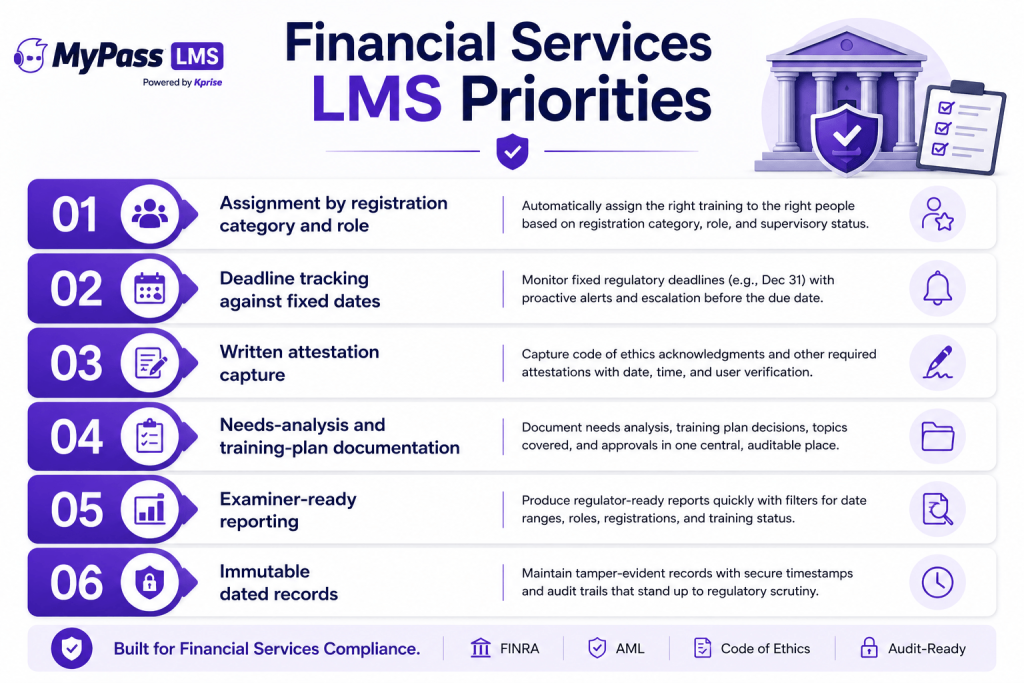
- Finance features: A Compliance Hub tracks compliance by program with expiration alerts; groups and roles drive assignment; Dynamic Reports and Export to Excel produce completion evidence; assessments support question pools and webcam proctoring review; SCORM courses load directly. The off-the-shelf Corporate Compliance pack covers anti-bribery, code of conduct, and IT security and data privacy. See how this maps to banking on the MyPass financial services page.
- Pricing: Published. Community Edition is $0 and self-hosted. Shared Hosting is $99/mo ($79/mo billed annually) with up to 50 simultaneous logins; Private Hosting is $319/mo ($249/mo annually) with up to 1,000; Enterprise is custom. Every plan includes unlimited registered users, with a 15-day free trial and no credit card.
- Caveat: There is no ready-made AML/BSA, fair lending or FINRA Firm Element course; you would load licensed courseware as SCORM or build your own. Policy attestation is not listed as a separate feature, so test how an acknowledgment is captured and reported. Kprise is a much smaller vendor than Cornerstone or Docebo, so ask early what security documentation it can provide for your third-party risk review.
8. Totara
- Who it suits: Institutions that want open, customizable code and a partner to host, configure and support it.
- Finance features: The Totara financial services page describes compliance training assigned "based on role, location, job function, and more" and completion and competency tracking to be "audit-ready." It says it was chosen by Western Union, Rabobank and Santander.
- Pricing: Not published; the page offers a demo. The Totara homepage points buyers to its global partner network for implementation.
- Caveat: Your day-to-day experience depends on the partner. Put the partner's hosting, security evidence and support hours through the same vendor review as the software.
Key point
Two kinds of vendor are left off this list on purpose. Bank-specific compliance providers such as BVS, which sells "compliance training built exclusively for banks and credit unions" alongside its Monarch LMS, lead with the course library rather than the platform; if BSA/AML and regulation courses are most of what you need, add one to your shortlist. Intellum has a financial services page, but its named customers (Gusto, Xero, FreshBooks) are fintech and accounting software firms training their customers, which is a different job.
What regulators and auditors expect your training records to show
Most finance training rules say little about course content and a lot about who must be trained and what must be documented. This table maps the main US obligations to what your LMS has to record.
| Obligation | Applies to | What the source says | What your LMS must record |
|---|---|---|---|
| BSA/AML program training | Banks (31 CFR 1020.210); credit unions (12 CFR 748.2) | "Training for appropriate personnel," alongside independent testing of the program | Role-based assignment, dated completions, test scores, late completions and corrective actions |
| FINRA Regulatory Element | Every registered person, including permissive registrations (FINRA Rule 1240) | Annually by December 31 for each registration category; miss it and registrations are deemed inactive | Who is due and their status; the content itself is completed on FINRA's platform |
| FINRA Firm Element | Registered persons at member firms | Annual needs analysis, written training plan, and records of program content and completion | Completions tied to the plan year and the course version delivered |
| Information security training | Banks (Interagency Guidelines); non-bank financial institutions (FTC Safeguards Rule) | "Train staff to implement" the security program; "security awareness training that is updated as necessary" | Annual and refresher completions, course updates with dates |
| Consumer compliance, including fair lending | FDIC-supervised banks (Consumer Compliance Examination Manual) | Examiners weigh whether training is "current and tailored to risk and staff responsibilities" | Separate assignments for lenders, underwriters and branch staff |
| Code of ethics acknowledgment | SEC-registered investment advisers (Rule 204A-1) | Supervised persons give written acknowledgment of receipt of the code and any amendments | A dated acknowledgment per person, repeated for each amendment |
The FFIEC BSA/AML Examination Manual's training section is the most specific about records. It says training should be tailored to each person's responsibilities (tellers on large currency transactions, loan staff on lending-related money laundering), that the board needs foundational training, and that it should be periodic rather than on a fixed interval. Our guide to AML training for employees covers what each role's module should include.
Broker-dealers often misread where the LMS fits. FINRA's continuing education page says the Regulatory Element is completed through FINRA's online CE platform via FinPro Gateway, so your LMS tracks it rather than delivers it. The Firm Element is yours to design and deliver, and Rule 1240(b)(2)(D) lets you count AML training under Rule 3310(e) and the annual compliance meeting toward it. Information security is similar: the rules require training but leave content to you, which is where cybersecurity awareness training modules and phishing refreshers come in.
Tip
Set an internal due date of November 30 for anything with a December 31 regulatory deadline, and schedule reminders at 30, 14 and 7 days with manager escalation on the last one. A registered person who misses December 31 has to stop registered activity until the Regulatory Element is done. A compliance training calendar keeps these dates in one place.
Evaluation criteria and weights for a financial services LMS
Score each finalist from 1 to 5 on every criterion, multiply by the weight and add up. Agree on the weights with your BSA officer or CCO, the training lead and whoever runs vendor management before the first demo.
| Criterion | Weight | What a 5 looks like |
|---|---|---|
| Evidence quality | 25% | Dated completions tied to course version, attestations, late completions and corrective actions, and a log of any admin change to a record |
| Rule-based assignment | 20% | Assignments driven by job code, branch, registration and supervisory status from your HR system, updated automatically on transfer |
| Deadlines and recertification | 15% | Fixed and rolling due dates, escalation to managers, recurring annual assignments without manual re-enrollment |
| Examiner and board reporting | 10% | A filtered completion report by person, course and date range in under a minute, exportable |
| Finance content | 10% | BSA/AML, fair lending and information security courses included, or easy SCORM import of courses you license |
| Vendor security evidence | 10% | A current SOC 2 report or equivalent, data location stated, and a completed due-diligence questionnaire |
| Three-year cost at your headcount | 10% | A total you can calculate from a published price or a written quote, including content add-ons |
Evidence quality outweighs content because content can be bought separately and records cannot be rebuilt after the fact. If you already run a broader program, our compliance training solution overview shows how assignment, expirations and reporting fit together on one platform.
Example
Platform A scores 5 on evidence quality and 2 on finance content; Platform B scores 3 on evidence and 5 on content. With the weights above, A gets 1.25 + 0.20 = 1.45 on those two lines and B gets 0.75 + 0.50 = 1.25. If the rest is even, A wins: you can license an AML course for A next week, but you cannot fix B's records once an examiner asks for them.
What these platforms cost at a 300-person bank
Only four of the eight publish a number, and each meters usage differently. Here is how a bank with 300 employees, all of whom take annual compliance training, lands on each published model:
- Per user per month (360Learning): Team stops at 100 users, so 300 staff means a custom Business quote.
- Annual platform fee (Litmos, Bridge): Litmos Foundation starts at $8K a year; Bridge starts at $15,000 a year on a typical three-year term, so at least $45,000 over the contract before add-ons.
- Active users (Docebo): 300 sits just above Docebo's suggested 250-learner floor. With annual training, monthly active users spike in the month everyone completes it, so compare monthly against yearly active-user pricing.
- Unlimited users with a login cap (MyPass): Shared Hosting is $948 a year billed annually but allows 50 simultaneous logins; if 80 people will be in courses during the last week of November, Private Hosting at $2,988 a year is the realistic plan.
Cornerstone, Absorb and Totara quote individually. Whatever the model, ask every vendor for a three-year total that includes the finance content library, extra tenants for external audiences, and implementation.
Questions to ask financial services LMS vendors
Send these in writing so the answers are on record. Our 15 questions to ask every LMS vendor cover general contract terms; these are the finance-specific ones.
- Can an administrator edit or delete a completion record, and is every change logged with who, when and why?
- How do you capture policy and code-of-ethics acknowledgments, and how do you trigger re-acknowledgment when a policy is amended?
- Which HR fields can drive assignment (job code, branch, registration, supervisory status), and what happens to open assignments when someone transfers?
- How are late completions recorded, and can we attach a corrective action to a missed deadline?
- When we update a course for a rule change, does each old completion still show the version the learner took?
- Which BSA/AML, fair lending and information security courses are in the base price, and who updates them when regulations change?
- Can we report FINRA Regulatory Element status next to Firm Element completions, even though the Regulatory Element runs on FINRA's platform?
- What security evidence will you give our third-party risk team: SOC 2 report, penetration test summary, data location, subprocessors?
- How long do you keep records for former employees, and can we export every record with timestamps if we leave?
- What is our three-year total, including content libraries, overage and implementation?
A 30-minute examiner test for every finalist
A sales demo shows the happy path. Give every finalist this script, have your training lead (not the sales engineer) drive it in a sandbox, and score as you go:
- Import three test users: a teller, a consumer loan officer and a registered representative. Show that each receives a different set of required courses from rules, not by hand.
- Assign annual BSA/AML training with a November 30 due date and show the reminder and escalation schedule.
- Amend the code of conduct. Show that everyone is asked to acknowledge the new version and that the old acknowledgments remain on file.
- Complete the loan officer's course after the due date. Show how the late completion and a corrective-action note appear on the record.
- Pull one report: everyone who completed BSA/AML training this year, with dates, course version and acknowledgment, exported to a file. Time it.
Anything a vendor cannot show live goes in your risk column. If step 5 takes more than a minute in a clean sandbox, it will take far longer with three years of real records.
Frequently asked questions
What is the best LMS for financial services?
There is no single best LMS for financial services. Platforms with named financial-services customers include Cornerstone, Docebo, Totara, Absorb and Bridge; Litmos sells finance compliance courses with its platform; 360Learning and MyPass LMS publish prices that suit smaller firms. Pick the one that can show, live in a demo, who completed which required course, by what date, with a dated acknowledgment.
Is FINRA Regulatory Element training completed in our own LMS?
No. FINRA says registered persons complete the Regulatory Element on its online CE platform, reached through FinPro Gateway, annually by December 31 for each registration they hold. Your LMS should track who is due and escalate before the deadline. The Firm Element is different: your firm designs and delivers it under a written training plan, so that is the part an LMS delivers and records.
How often do bank employees need BSA/AML training?
The regulations require training for appropriate personnel but set no fixed interval. The FFIEC BSA/AML Examination Manual expects new staff to get an overview at or soon after orientation and appropriate personnel to receive periodic training covering regulatory changes, internal policies, and changes to products, customers and locations. If you choose an annual cycle, add role-specific modules and document why that frequency fits your risk profile.
Does AML training count toward FINRA Firm Element?
It can. FINRA Rule 1240(b)(2)(D) says a member may consider a registered person's participation in AML compliance training under Rule 3310(e) and annual compliance training under Rule 3110(a)(7) toward the Firm Element requirement. It is the firm's choice, so record the decision in your written training plan and make sure each completion is tied to the right plan year.
What training records do examiners expect from a bank?
For BSA/AML, the FFIEC manual says banks should document training materials, any testing, session dates, attendance, failures to complete training on time and the corrective actions taken, and make them available to auditors and examiners. In practice that means per-person, dated completion records tied to the course version, plus a log of late completions and follow-up.
Keep reading
Choosing an LMS
Best LMS for Government and Public Sector Organizations
Choosing an LMS
Best LMS for Logistics and Transportation: A Buyer's Guide

Choosing an LMS
Best LMS for Hospitality: Hotels, Restaurants and Beyond

Choosing an LMS